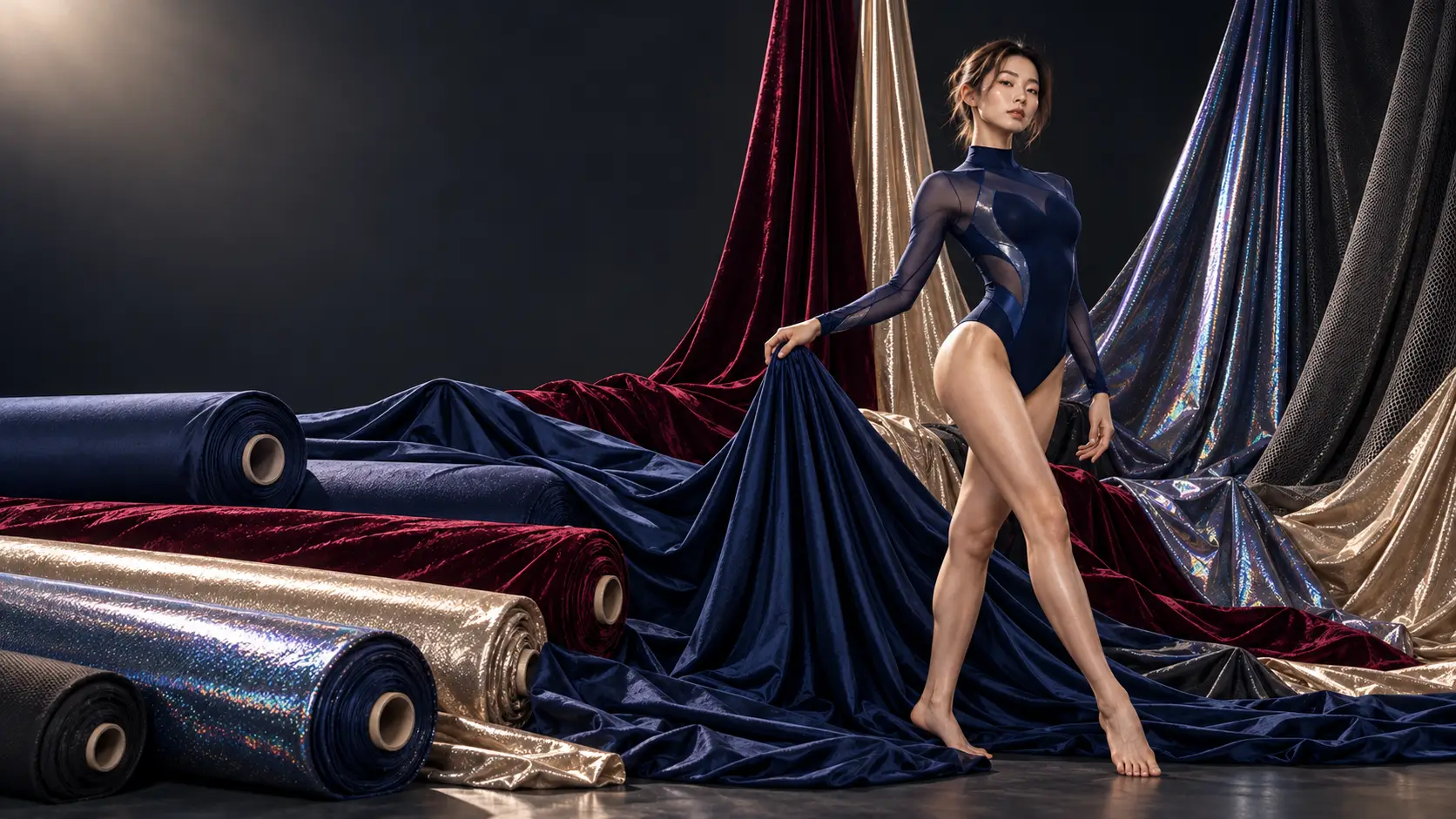
Wholesale Stretch Fabric by the Roll for European Importers and Distributors
European fabric wholesalers can explore Korean stretch fabric sourcing through WOODA CORP., LTD., a Korea-based performance textile sourcing and development company. Its material categories include technical stretch tricot, metallic stretch fabrics, holographic textiles, stretch velvet, and performance mesh. Buyers can request fabric samples and discuss roll-based purchasing conditions according to the selected product.
Expand Beyond Basic Jersey with Korean Performance Fabrics, Metallic Stretch Materials, and Specialty Textiles
For European fabric wholesalers, the next valuable addition to a collection may not be another basic jersey. It may be a distinctive performance fabric that existing customers cannot easily source from conventional distributors.
Wholesale stretch fabric by the roll gives importers and professional resellers an opportunity to serve fashion designers, apparel manufacturers, dancewear specialists, and performance-costume makers through carefully selected fabric categories.
But introducing new materials should not require an immediate commitment to a large, untested inventory.
The smarter approach is to identify commercially relevant fabrics, evaluate physical samples, understand purchasing conditions, and build a focused assortment before expanding.
For wholesalers looking beyond commodity textiles, Korean technical stretch fabrics offer an additional sourcing direction worth exploring.
1. Why European Fabric Wholesalers Need More Than Basic Jersey
Basic jersey, polyester blends, and Lycra-type stretch fabrics remain important products for the European textile trade.
However, wholesalers competing primarily on price often face a difficult commercial question:
How can we give professional customers a compelling reason to choose our catalogue over a competing supplier?
One potential answer is product differentiation.
A distributor already selling stretch jersey can explore adjacent categories without abandoning its established customers.
Consider the opportunities created by adding:
High-recovery 4-way stretch tricot for movement-intensive apparel.
Metallic and Mystique stretch fabrics for visually distinctive garments.
Holographic and iridescent textiles for stagewear and fashion collections.
Stretch velvet for dancewear, costume design, and fashion applications.
Performance mesh for coordinated garment construction.
These materials can complement an existing wholesale assortment while opening conversations with specialist buyers.
Rather than competing only on the cheapest metre of fabric, distributors can compete through material selection, technical understanding, and a more distinctive collection.
The Commercial Opportunity: Sell More Than a Fabric
A costume manufacturer may need several compatible materials for one collection.
For example, a dancewear producer might require a metallic stretch base, coordinating mesh, and stretch velvet for different garment panels.
A distributor able to offer these categories can become a more useful sourcing partner.
The opportunity is not simply to add more SKUs. It is to make the existing catalogue more relevant to customers with specialised material requirements.
2. Test Wholesale Stretch Fabric by the Roll Before Expanding Inventory
Inventory commitment is one of the most important considerations when evaluating an unfamiliar overseas supplier.
Ordering too many colours, designs, or fabric constructions before understanding local demand can increase stockholding exposure.
A sample-first, trial-order approach provides a more measured alternative.
A Practical 300-Yard Trial Scenario
A European distributor might consider approximately 300 yards (274 metres) as an initial purchasing scenario for evaluating a selected specialty fabric range.
Depending on actual roll lengths, this could represent roughly four to five rolls.
A hypothetical trial assortment could include:
| Fabric Category | Potential Customer Segment |
|---|---|
|
01
4-Way Stretch Tricot
|
Sportswear and fitted performance apparel |
|
02
Metallic Stretch Fabric
|
Gymnastics, dance, and performance costumes |
|
03
Holographic Stretch Fabric
|
Stagewear, fashion, and event apparel |
|
04
Stretch Mesh or Velvet
|
Costume makers and specialist fashion designers |
This is an illustrative commercial planning model, not a confirmed minimum order quantity or fixed WOODA trial package.
Actual roll lengths, mixed-fabric eligibility, colour availability, pricing, and minimum order requirements must be confirmed for each product.
Five Questions Before Committing to Stock
Before introducing a new specialty fabric, wholesalers should ask:
Does the fabric serve an existing customer category?
Is the material visibly or technically differentiated from current stock?
Can the selling price accommodate freight, duties, handling, and an appropriate wholesale margin?
Are the technical specifications and replenishment conditions clear?
Can the material be evaluated through physical samples before bulk approval?
A disciplined sourcing process can help separate an attractive material from a commercially suitable product.
3. Four Specialty Fabric Categories Worth Evaluating
High-Recovery 4-Way Stretch Tricot
Four-way stretch tricot is especially relevant where garment fit and freedom of movement are important.
Potential applications include gymnastics apparel, dancewear, training garments, and other fitted performance clothing.
However, the fibre composition alone does not establish fabric performance.
Professional buyers should review:
Stretch characteristics in both fabric directions.
Recovery and residual growth after extension.
Fabric weight and usable width.
Opacity under tension.
Hand feel and garment construction suitability.
Available colourways and production consistency.
These considerations help distributors provide more useful technical recommendations to their customers.
Metallic and Mystique Stretch Fabrics
Some apparel markets prioritise visual performance as well as physical movement.
Gymnastics, cheerleading, ballroom dance, figure skating, and stage productions frequently incorporate reflective and metallic surface effects into costume design.
Metallic and Mystique stretch fabrics are relevant to customers looking for distinctive visual materials.
For wholesalers, their commercial appeal lies in offering a category that differs clearly from conventional solid-colour stretch jersey.
What should buyers inspect?
Examine the surface both relaxed and stretched. Review reflection under different lighting conditions, the appearance of the finish after handling, and its suitability for the intended garment.
Do not assume that every metallic fabric has the same durability, recovery, or cleaning characteristics.
Physical evaluation and product-specific technical information remain essential.
Holographic and Iridescent Stretch Fabrics
Holographic and iridescent effects can change visually with light direction, viewing angle, and garment movement.
These characteristics create design possibilities for performance costumes, fashion applications, and event apparel.
For professional wholesalers, a focused collection of holographic materials can provide an additional reason for designers and specialist retailers to explore the catalogue.
Buyers should assess the material under representative lighting conditions and check its behaviour during intended garment movement.
Stretch Mesh and Velvet
Coordinating fabrics are often as commercially useful as the main decorative material.
Stretch mesh can be evaluated for its transparency, elasticity, weight, and suitability for garment panels.
Stretch velvet introduces another surface texture and distinctive light response.
Offering complementary categories can make a wholesale assortment more useful to manufacturers sourcing multiple materials for one garment.
Exact colour matching between different fabric constructions should always be assessed through physical samples.
4. Protect Wholesale Margins: Evaluate Total Landed Cost
The lowest supplier quotation does not always produce the strongest commercial outcome.
European importers need to consider the total cost of placing fabric into available stock.
This may include:
Purchase price and agreed currency.
International freight and shipment consolidation.
Customs duties and import taxes.
Customs brokerage and local handling.
Inspection, testing, and sampling costs.
Warehouse storage and inventory financing.
or example, a distinctive specialty fabric may support a different wholesale selling price from a commodity jersey.
However, that potential must be assessed against actual customer demand, competitive alternatives, and total acquisition cost.
The commercial objective is not simply cheaper fabric. It is a product assortment that can support sustainable distribution margins.
A sourcing partner who communicates specifications, quantities, lead times, and shipment conditions clearly can help buyers make better purchasing decisions.
5. What French and EU Fabric Importers Should Check
Importing technical and specialty textiles into the European Union requires attention to product documentation, labelling, and applicable chemical restrictions.
For textile fibre names and composition labelling, importers should assess the requirements of Regulation (EU) No 1007/2011.
Depending on the product and intended market, relevant REACH restrictions and other applicable obligations may also need consideration.
Buyers should review the documentation available for the specific fabric rather than assume that a supplier’s general statement or one certificate covers every material.
Essential Sourcing Information
Before approving a product for wholesale distribution, request or confirm:
| Information | Why It Matters |
|---|---|
|
01
Fibre composition
|
Material identification and applicable labelling |
|
02
Width and GSM
|
Product comparison and customer specification |
|
03
Stretch and recovery
|
Suitability for intended use |
|
04
Colour and finish information
|
Approval and replenishment planning |
|
05
Roll length and packing
|
Warehouse and distribution planning |
|
06
Available test documentation
|
Product-specific technical evaluation |
|
07
MOQ and lead time
|
Purchasing and stock planning |
|
08
Incoterms and shipping details
|
Landed-cost assessment |
For products intended for performance apparel, physical testing and garment trials can provide information that a digital catalogue alone cannot deliver.
Specialty surface finishes may require additional attention to stretching, care conditions, and repeated handling.
The precise documentation needed will depend on the textile, intended use, destination market, and applicable legal requirements.
6. A Five-Step Approach to Building a Specialty Fabric Collection
Step 1 — Identify Existing Customer Demand
Begin with customer segments already served by the business.
A fashion-fabric wholesaler might evaluate stretch velvet and metallic fabrics. A sportswear-focused distributor might prioritise technical tricot and performance mesh.
Choose products that extend current capabilities rather than create unnecessary complexity.
Step 2 — Request an Application-Based Swatch Selection
Compare the physical qualities of potential products.
Examine appearance, hand feel, colour, stretch, recovery, surface finish, and overall relevance to the intended applications.
Step 3 — Review Technical and Commercial Conditions
Confirm available specifications and discuss indicative pricing, minimum quantities, roll configurations, sampling conditions, and possible shipping arrangements.
Separate confirmed product specifications from preliminary purchasing discussions.
Step 4 — Introduce Selected Samples to Customers
Present a limited selection to relevant professional buyers.
Record enquiries, preferred colours, target price expectations, and potential purchasing volumes.
This feedback can inform which materials deserve further commercial evaluation.
Step 5 — Develop Repeat-Order Planning
Once demand has been assessed, discuss replenishment possibilities, available production options, and future collection extensions with the supplier.
This process gives wholesalers a structured route from initial interest to longer-term sourcing discussions.
7. Discover Korean Performance Fabrics with WOODA
WOODA CORP., LTD. is a Korea-based performance textile sourcing and development company with more than 30 years of industry experience.
WOODA works with international B2B customers seeking specialised fabrics for movement-intensive and visually distinctive apparel.
Our sourcing and development focus includes:
Nylon and polyester-spandex stretch fabrics.
Performance tricot and stretch jersey.
Metallic and Mystique stretch textiles.
Holographic and iridescent materials.
Stretch velvet and performance mesh.
Selected decorative and printed stretch fabrics.
We understand that professional importers need more than attractive catalogue photographs.
They need relevant product information, clear communication, and the opportunity to evaluate materials before making purchasing decisions.
Whether your business distributes conventional stretch fabrics or serves specialist costume and performancewear manufacturers, WOODA can discuss suitable material categories and available sample options.
8. Request a Fabric Swatch Selection for Your Wholesale Collection
Looking for new stretch fabrics that could differentiate your wholesale catalogue? Start with the materials, not a bulk commitment.
Tell WOODA what you currently distribute and which customer markets you want to develop.
We can review your enquiry to help identify relevant fabric categories and discuss available swatches and sourcing conditions.
For a more useful recommendation, include:
Your company and destination country.
The fabric categories you are interested in.
Your customers’ intended applications.
Preferred colours, finishes, or design direction.
Estimated quantities or target roll requirements.
Discover technical stretch bases, reflective surfaces, and complementary fabrics selected around your sourcing needs.
WOODA — Moves with you. Shines with you.
Frequently Asked Questions
Essential answers for European fabric wholesalers, distributors, and professional textile buyers.
01 Can European wholesalers source Korean stretch fabric by the roll?
Roll-based sourcing can be discussed with Korean fabric suppliers. Actual purchasing conditions depend on the selected fabric, available stock, roll configuration, production requirements, and agreed minimum quantity.
02 Is a 300-yard trial order possible?
A 300-yard quantity can be proposed as an initial purchasing scenario. It is not a universal minimum order quantity. Availability and feasibility should be confirmed directly for each product and colour.
03 Which Korean specialty fabrics can complement a conventional jersey collection?
Potential categories include four-way stretch tricot, metallic stretch fabrics, holographic textiles, stretch mesh, and stretch velvet. The most suitable selection depends on existing customers and market demand.
04 What is the difference between conventional jersey and performance tricot?
Jersey commonly refers to weft-knitted fabric constructions, while tricot is generally a warp-knit construction. Actual suitability for performance applications depends on composition, construction, stretch, recovery, weight, and finishing.
05 What should EU importers verify before ordering specialty fabrics?
Buyers should review fibre composition, technical specifications, product-specific testing information where available, relevant chemical restrictions, labelling requirements, shipping terms, and the commercial documents needed for importation.
06 How can a fabric wholesaler request samples from WOODA?
Professional buyers can use the WOODA fabric sample enquiry page to share their preferred fabric categories, target applications, quantities, and delivery destination.
Wholesale Stretch Fabric by the Roll | European B2B Guide
Source wholesale stretch fabric by the roll from Korea. Explore metallic, holographic and technical fabrics for EU distributors. Request WOODA swatches.
European fabric importers should review applicable chemical restrictions before sourcing specialty textiles. For official regulatory information, consult the European Chemicals Agency (ECHA) REACH restrictions .

Mystique Fabric Wholesale for Gymnastics | WOODA
Mystique fabric is more than a metallic look. For gymnastics and dancewear manufacturers, color consistency, stretch recovery, comfort, and surface appearance under movement influence every material decision. Learn how to evaluate and develop your next Mystique collection.
Commercial investigation / B2B material sourcing. Experienced manufacturers are comparing metallic stretch materials, evaluating custom color options, and identifying suppliers for new production programs.

Custom Stretch Fabric Wholesale | Exclusive Collections
Your next best-selling fabric may start with a new surface. Discover how wholesalers can expand their stretch fabric collections through custom foil, holographic finishes, coordinated base fabrics, and a focused sampling-to-production process.

Custom Foil Stretch Fabric for Wholesale Collections | WOODA
Discover how fabric wholesalers can develop distinctive foil and holographic stretch collections with custom surface finishes, coordinated performance materials, and practical sourcing strategies. WOODA Korea explores how specialty fabric development can turn individual swatches into commercially relevant collections.
복사

답글 남기기