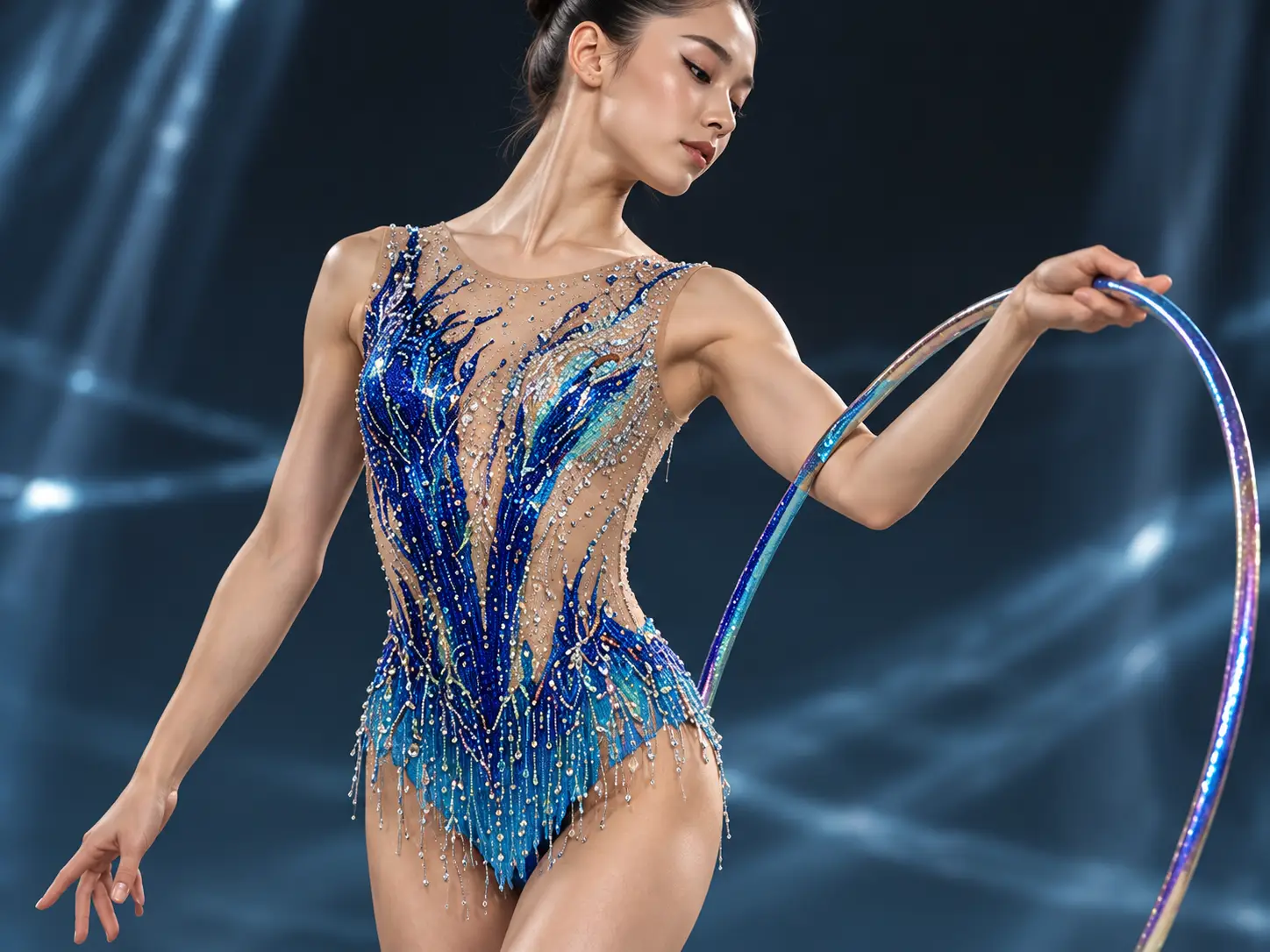
Gymnastics Leotard Preferences Are Not the Same in Every Market
There is no single “Russian,” “American,” or “European” gymnastics uniform. Preferences vary by discipline, athlete level, club identity, price point, designer, and competition regulations.
However, buyers can still identify useful market tendencies.
Rhythmic gymnastics often allows much stronger theatrical expression than traditional artistic gymnastics, while competitive artistic gymnastics frequently emphasizes a cleaner athletic silhouette combined with strategic sparkle, color transitions, mesh, metallic surfaces, or crystals.
International regulations also place practical limits on what designers can do. Current FIG rhythmic gymnastics rules permit different sleeve lengths, transparent sleeve materials, attached skirts within defined limits, and decorative appliqués as long as they remain safe and close to the garment. Competition attire is checked for compliance.
This means successful gymnastics apparel begins with a balance:
performance first, visual identity second—and ideally both at the same time.


Russia: Dramatic, Artistic and Couture-Inspired Performance Looks
Russia has a particularly strong historical association with rhythmic gymnastics, where costume design is closely connected with choreography, music, body lines, and stage presentation.
Rather than treating this as a universal national preference, it is more accurate to say that the Russian rhythmic-gymnastics design segment strongly demonstrates a high-decoration, custom-performance approach.
Russian ateliers currently promote made-to-measure garments featuring stretch mesh, Lycra-type fabrics, hand-applied crystals, dimensional decoration, artistic color treatments, and designs intended to emphasize movement and silhouette. Some Russian competition models use hundreds or even thousands of crystals, while custom ateliers emphasize individual design and close body fit.
For buyers targeting this type of market, suitable fabrics may include:
- rich, highly saturated stretch bases;
- smooth polyester-spandex or nylon-spandex constructions;
- stretch mesh for illusion panels and sleeves;
- shiny or metallic surfaces;
- fabrics compatible with foil, print, crystals, appliqués, and decorative construction;
- strong recovery to maintain the intended silhouette underneath heavy visual decoration.
The important point is that decoration cannot compensate for poor fabric performance. A visually spectacular costume still needs to move naturally through leaps, turns, balances, splits, and rapid directional changes.


United States: Athletic Impact Meets Custom Team Identity
The U.S. gymnastics market has a large artistic gymnastics and club competition culture, creating demand for apparel that is both performance-driven and highly recognizable.
Contemporary U.S. competition styles demonstrate strong use of ombré effects, sublimated patterns, stretch mesh overlays, holographic surfaces, crystals, team colors, and customized branding. Current GK Elite competition products, for example, combine mesh, ombré sublimation, sparkle hologram materials, crystal decoration, and custom team elements.
At the same time, apparel must comply with competition requirements. USA Gymnastics rules address acceptable leotard construction, coverage, visible undergarments, fit, and other attire considerations, so designers cannot focus on appearance alone.
For U.S.-oriented collections, manufacturers may therefore look for gymnastics leotard fabric that can support:
high-impact team color stories, digital or sublimation-style visual effects, strategically placed shine, smooth stretch, dependable recovery, and consistent production across multiple athlete sizes.
The result is often a more athletic graphic appearance than a heavily couture-inspired rhythmic costume, although premium competition garments can still contain significant crystal and metallic detailing.


Europe: From Elegant Club Uniforms to Contemporary Performance Fashion
Europe is too diverse to describe with one aesthetic.
The UK, Germany, France, Italy, Spain, the Netherlands, Poland, Scandinavia, and other markets have different club traditions, price structures, disciplines, and design preferences.
Still, European suppliers demonstrate a strong market for clean silhouettes combined with selective premium effects.
British gymnastics collections, for example, currently include smooth velour/Lycra constructions, crystal motifs, holographic panels, super-shine contrast fabrics, ombré effects, and asymmetric styling.
This creates opportunities for manufacturers to build collections around several directions rather than one exaggerated aesthetic: elegant solid colors with restrained shine, sophisticated metallic accents, modern ombré graphics, stretch mesh inserts, crystal-compatible surfaces, and brighter statement fabrics for competition programs.
For European buyers, versatility can be especially valuable because one fabric platform may need to serve club uniforms, competitive artistic gymnastics, dance-inspired performance garments, or related activewear programs.


What Every High-Performance Gymnastics Fabric Should Deliver
1. Four-Way Stretch
Gymnastics involves extreme extension in several directions. A suitable fabric should follow the athlete without creating excessive resistance during splits, leaps, rotations, backbends, or overhead movement.
2. Strong Recovery
Stretch alone is not enough.
After extension, the garment should return toward its intended shape. Poor recovery can contribute to sagging, loose areas, distorted seams, or an inconsistent fit.
3. Lightweight Comfort
Competition garments may combine base fabric, mesh, lining, crystals, foil effects, and other decoration. Starting with a balanced lightweight performance fabric can help designers manage the total garment structure.
4. Smooth Hand Feel
A gymnast performs with the garment close to the skin for extended periods. Hand feel, seam interaction, softness, and stretch comfort therefore matter alongside visual appearance.
5. Color and Finish Consistency
For team orders, brands and manufacturers may need multiple production quantities to maintain a consistent identity.
Buyers should evaluate color consistency, surface appearance, finish quality, and compatibility between base fabrics, mesh, shiny fabrics, and decorative components.
6. Durability Appropriate to the Application
Training wear and competition wear have different priorities.
Training apparel may require frequent laundering and repeated abrasion resistance. Competition garments may prioritize sophisticated surfaces and decoration but still need enough stability to survive fitting, performance, transportation, and handling.
Foil and metallic effects should also be evaluated according to the intended use because repeated friction and washing can affect some shiny finishes over time; commercial gymnastics suppliers provide specific care instructions for these materials for this reason.

Why Fabric Selection Matters in High-Movement Sportswear
A gymnastics leotard is one of the clearest examples of why performance textile development must consider movement, appearance, and garment engineering together.
Extreme movement places repeated stress on the fabric across the shoulders, torso, hips, leg openings, sleeves, and decorative areas. A fabric with inadequate stretch or recovery can interfere with fit, while an unstable surface can make complicated embellishment or panel construction more difficult.
International buyers should therefore evaluate more than a fabric photograph or color card.
Important sourcing considerations include fiber composition, GSM, usable width, four-way stretch, stretch recovery, hand feel, opacity, surface finish, color consistency, decoration compatibility, sample availability, MOQ, expected lead time, and supplier communication.
These considerations are especially important when several fabrics must work together in one garment.


Why WOODA for Brighter, More Distinctive Gymnastics Collections?
Visual differentiation is one of the biggest opportunities in competitive gymnastics apparel.
A standard solid stretch fabric can provide functionality. But when a designer wants a leotard to look brighter, more energetic, more luxurious, or more visible under competition lighting, the material palette becomes much more important.
WOODA supports this type of development through experience with performance stretch fabrics, shiny fabrics, foil print fabrics, novelty fabrics, tricot, mesh, and polyester-spandex constructions suitable for performance-apparel development.
That gives designers the possibility of combining different visual surfaces within one collection: a clean high-stretch base, transparent or decorative mesh, reflective shine, foil effects, or distinctive novelty textures.
For gymnastics apparel companies, dancewear brands, cheerleading manufacturers, skating costume designers, and performance-wear developers, sourcing complementary materials from an experienced Korean textile supplier can also simplify development discussions.
Rather than asking only, “Which fabric looks the brightest?” the more useful questions are:
How does it stretch?
How does it recover?
How does the shine behave when the fabric is extended?
How does it feel against the body?
Does the color remain visually consistent?
Can it coordinate with mesh or other decorative fabrics?
Is it appropriate for the intended training or competition application?
With more than three decades of textile experience behind the WOODA business, the objective is not simply to offer a decorative fabric, but to help international buyers explore materials capable of combining performance, movement, color, surface interest, and stage-ready visual impact.
Buyers can explore WOODA through woodatex.com and texro.com when developing gymnastics, dancewear, skating, cheerleading, swimwear, activewear, and other performance-apparel programs.

Conclusion
Gymnastics apparel markets may express performance differently.
Russian rhythmic-gymnastics design demonstrates the appeal of theatrical customization and rich embellishment. U.S. competition apparel frequently combines athletic team identity with ombré, mesh, crystals, sublimated graphics, and holographic effects. European markets show a broad mix ranging from refined club styles to modern high-shine competition looks.
But beneath every successful design is the same requirement: the fabric has to perform.
For brands and apparel manufacturers looking to create gymnastics leotards that are flexible, comfortable, visually memorable, and suitable for demanding movement, the right combination of four-way stretch, recovery, hand feel, lightweight construction, color, mesh, shine, and decorative compatibility can make a significant difference.
And when the design brief calls for something brighter, more colorful, more dynamic, and more stage-ready, WOODA’s performance and specialty fabric range gives designers more tools to turn technical gymnastics wear into distinctive performance apparel.
댓글 남기기