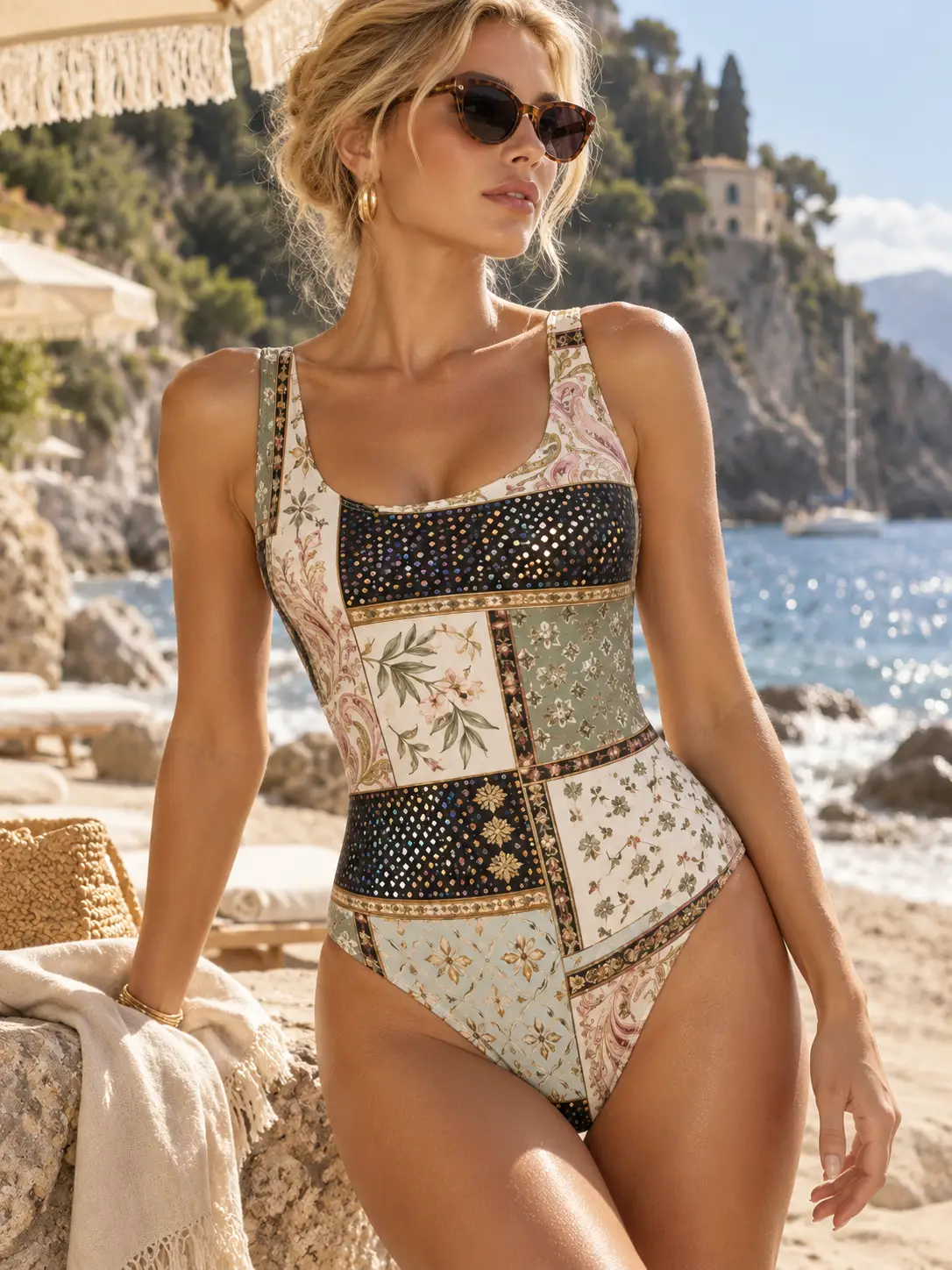
A premium swimwear fabric supplier should offer more than basic stretch. For modern swimwear and resortwear brands, differentiation increasingly comes from the combination of stretch, recovery, soft hand feel, surface character, color, printability, controlled shine, and coordinated collection development.
Stretch is expected. Differentiation begins after stretch.
Premium swimwear brands are looking beyond standard solid swim fabrics toward materials that can create a stronger visual and tactile identity. Soft polyamide-elastane fabrics, printable polyester-elastane bases, reversible concepts, subtle metallic finishes, pearlescent surfaces, lightweight resort fabrics, and coordinated prints can all help a collection feel more distinctive.
For buyers searching for a premium swimwear fabric supplier, the objective is not simply to find a fabric that stretches. It is to find the right material platform for the intended swimsuit, bikini, one-piece, pareo, cover-up, or complete resort collection.
What Premium Swimwear Brands Need From Fabric Today
A good swimwear fabric supplier should understand that stretch alone does not define a premium material.
Swimwear buyers often evaluate:
- Four-way stretch
- Stretch recovery
- Soft hand feel
- Opacity under extension
- Fabric weight and usable width
- Color consistency
- Printability
- Surface appearance
- Comfort against the skin
- Durability requirements
- Compatibility with the final garment design
A 4 way stretch swimwear fabric may provide the movement required for a body-hugging silhouette, but recovery is equally important. A fabric that stretches easily but does not recover appropriately may lose its intended appearance depending on garment construction and use.
For this reason, a professional swimwear fabric supplier should help buyers compare stretch and recovery together rather than treating elasticity as a single specification.

From Swimwear to Resortwear: Building a Complete Material Story
Many swim collections now extend visually beyond the swimsuit itself.
A coordinated collection may include:
- Bikinis
- One-piece swimsuits
- Pareos
- Lightweight cover-ups
- Kimonos
- Resort dresses
- Relaxed pants
- Matching tops
This creates an opportunity for brands to develop a connected material story instead of sourcing each product separately.
A resortwear fabric supplier may therefore need to work alongside the swimwear material program. Stretch fabrics can support bikinis and one-pieces, while lightweight woven or draping fabrics can carry related colors, prints, or motifs into pareos and cover-ups.
For sourcing teams, the strongest strategy is often not to make every product from the same fabric, but to coordinate color, print scale, surface mood, and collection identity across different fabric constructions.

Six Fabric Directions for Premium Swimwear and Resortwear
1. Soft Shine: Subtle Luxury Under Natural Light
A soft-shine polyamide elastane fabric can create a polished swimwear surface without relying on extreme metallic reflection.
Possible directions include:
- Soft pearl
- Controlled wet-look effects
- Fine surface texture
- Low-contrast iridescence
- Smooth premium hand feel
This direction can work especially well for one-piece swimsuits, halter silhouettes, premium solid-color bikinis, and resort-focused swim collections.
The goal is not maximum shine. It is controlled shine.
A premium swimwear fabric should respond beautifully to natural light while remaining sophisticated enough for luxury swim and resort positioning.

2. Reversible Swimwear Fabric: Two Material Stories in One Garment
A reversible swimwear fabric program can give brands more versatility from a single garment.
Instead of developing only print-to-print reversible concepts, buyers can also explore combinations such as:
Printed Side ↔ Coordinated Solid Side
or
Visual Pattern ↔ Subtle Surface Effect
A printable polyester elastane swimwear fabric can be especially useful when the collection depends on detailed color or repeatable graphic direction.
For triangle bikinis, bandeau styles, tie-side bottoms, and other reversible constructions, brands should evaluate both surfaces carefully, including hand feel, stretch balance, opacity, recovery, sewing behavior, and appearance after extension.
3. Second-Skin Polyamide: When Hand Feel Becomes Part of the Product
For skin-contact garments, hand feel can become one of the first qualities a customer notices.
A soft polyamide elastane fabric can support a smooth, comfortable, second-skin direction for premium swimwear.
Possible surface developments include:
- Micro rib
- Fine jacquard
- Tone-on-tone texture
- Soft matte surfaces
- Fine lustrous surfaces
This type of stretch fabric for swimwear can be considered for full-cover silhouettes, one-pieces, minimalist bikinis, and collections where tactile quality is part of the brand story.
A premium swimwear fabric should not only look attractive in photography. It should also feel appropriate when the customer touches and wears it.
4. Recycled Stretch: Sustainability With Design Flexibility
For brands evaluating recycled swimwear fabric, material selection still needs to begin with the garment concept.
Depending on project requirements, recycled polyester-elastane or other recycled-content stretch bases may be considered for printed swimwear programs.
Buyers should evaluate:
- Stretch
- Recovery
- Print response
- Color quality
- Opacity
- Weight
- Hand feel
- Surface stability
- Intended end use
Sustainability should not require abandoning design identity. The more useful approach is to develop the visual and performance requirements first and then evaluate suitable recycled material options that can support them.
5. Metallic Swimwear Fabric: Shine Designed for Sunlight
A metallic swimwear fabric does not need to look like stagewear.
For resort and fashion swimwear, surface effects can be reduced and refined.
Instead of maximum reflection, buyers may consider:
- Tonal pearl
- Selective foil
- Fine iridescence
- Micro holographic effects
- Wet-look surfaces
- Low-contrast metallic details
The key concept is simple:
Metallic should behave like sunlight, not stage glitter.
This is especially important for brands exploring pearlescent swimwear fabric, iridescent stretch fabric, or subtle foil effects.
A supplier experienced in surface treatments can help translate decorative textile techniques into a more controlled direction appropriate for swim and resort collections.
6. Resort Drape: Connecting Swimwear With the Complete Look
The swimwear fabric does not have to carry the entire collection.
For pareos, kimonos, dresses, wide pants, and beach cover-ups, brands may consider lightweight woven constructions with fluid drape and coordinated print development.
A useful collection strategy is to adapt the same design language at different scales.
For example:
- Bikini: smaller print scale
- Pareo: enlarged print scale
- Kimono: oversized crop or placement
- Dress: coordinated repeat
- Solid swimsuit: color taken from the print story
This creates a recognizable swim-to-resort system while allowing each fabric construction to perform according to its intended garment.
How Surface Effects Should Change for Swimwear
Premium swimwear and resortwear are often viewed in sunlight rather than under concentrated performance lighting.That difference should influence surface development.
From Visual Impact
to Elevated Shine.
For premium swimwear, surface design is not simply about creating more shine. It is about controlling how the material responds to color, movement, stretch and natural light.
High-Impact
Surface Direction
Premium Swim /
Resort Direction
Not simply more shine.
Better-controlled shine.
For a premium swimwear fabric supplier, this shift is important.
The objective is not simply to apply an existing shiny finish to a swimsuit fabric. The surface needs to be considered together with color, stretch, hand feel, sunlight response, garment silhouette, and the positioning of the collection.

How to Choose the Right Swimwear Fabric Base
Polyamide / Elastane
A polyamide elastane fabric may be considered when buyers prioritize a soft hand feel, body comfort, premium solid colors, and a smooth second-skin sensation.

Polyester / Elastane
A polyester elastane swimwear fabric can be attractive for printed programs because polyester constructions are widely considered for color and print applications.
The exact suitability depends on the selected construction, finish, printing process, and required end use.


Recycled Stretch Fabrics
Recycled-content fabrics can support sustainability objectives when the selected material also meets the design and technical requirements of the collection.

Lightweight Resort Fabrics
Pareo and cover-up fabrics require different characteristics from swimsuit fabrics. Buyers may prioritize lightness, drape, print clarity, softness, airflow, and movement.
There is no single “best” swimwear fabric. A knowledgeable swimwear fabric manufacturer or supplier should help match the base fabric to the intended garment and design direction.
What Brands Should Test Before Production
Before approving commercial production, buyers should establish appropriate testing requirements for the selected fabric and garment application.
Depending on the project, brands may consider evaluating:
- Stretch percentage
- Recovery
- Opacity under stretch
- Wet and dry appearance
- Colorfastness
- Water exposure
- Chlorine exposure
- Salt-water exposure
- Abrasion
- Drying characteristics
- Print stability
- Surface adhesion
- Foil or decorative finish stability
- Hand feel after care testing

These are recommended evaluation areas rather than universal performance claims. Final requirements should be agreed according to the selected fabric, buyer test protocol, garment construction, and intended market.
What International Swimwear Buyers Should Evaluate
International buyers selecting a premium swimwear fabric supplier often need more information than a fabric photograph or composition percentage.
Professional sourcing teams may evaluate:
Composition → GSM → Width → Stretch → Recovery → Hand Feel → Opacity → Finish → Color Consistency → Sample Process → MOQ → Lead Time → Communication
High-movement apparel places significant demands on fabric behavior. Four-way stretch can support multidirectional movement, while recovery helps a material return toward its intended shape. Hand feel affects skin-contact comfort, and fabric weight can influence both silhouette and wearing experience.
Shine and surface treatments should also be evaluated in relation to the finished garment. A subtle pearlescent surface may support one resort collection, while another program may need a matte, printed, or textured base.
Experienced Korean textile sourcing can be attractive to buyers seeking a combination of stretch-fabric knowledge, technical communication, surface development, print options, and sample-based evaluation.

WOODA works with international buyers across performance and stretch textile categories and can be explored through the official websites:
WOODA / WOODATEX Official Website
For buyers specifically researching swim applications:
Premium Swimwear & Swimsuit Fabrics by WOODA
This dedicated swimwear page includes polyester-spandex tricot, nylon-spandex four-way stretch, and related swim-oriented material directions.


How WOODA Approaches Swim & Resort Material Development
A productive B2B material-development process can follow a structured sequence:
Base Fabric → Surface → Color → Print → Sample → Prototype → Buyer Testing → Production
Rather than beginning with an oversized catalog, sourcing discussions can start with the actual garment program.
A buyer developing a premium bikini line may prioritize soft polyamide-elastane and controlled shine.
A printed collection may begin with polyester-elastane bases.
A resort extension may require coordinating prints across stretch fabrics and lightweight draping materials.
A fashion-forward collection may explore subtle pearl, iridescent, wet-look, or selective foil development.
This makes the relationship more than a simple search for a swimwear fabric supplier. It becomes a material-development conversation around the complete collection.
The modern premium swimwear market requires more than elasticity.
The right premium swimwear fabric supplier should help brands evaluate stretch, recovery, hand feel, color, printability, surface character, collection coordination, and application-specific testing.
Soft-shine polyamide, reversible fabrics, second-skin textures, recycled stretch materials, metallic sunlight effects, and coordinated resort fabrics each provide a different route toward collection differentiation.
For international buyers developing swimwear, resortwear, bikinis, one-piece swimsuits, pareos, cover-ups, or coordinated vacation collections, WOODA offers a Korean textile-development perspective focused on movement, surface, light, and material development.
Explore the dedicated WOODA swimwear fabric page, visit woodatex.com or texro.com, and contact WOODA to discuss fabric swatches, sample availability, and project-specific requirements.
premium swimwear fabric supplier
Premium swimwear starts with more than stretch.
Explore six material directions for modern swim and resort collections—from soft polyamide-elastane and reversible prints to second-skin textures, recycled stretch, controlled metallic shine, and coordinated resort fabrics.
For brands searching for a premium swimwear fabric supplier, WOODA supports material development from Korea with a focus on stretch, recovery, hand feel, surface innovation, print, color, and buyer-led sampling.
Explore WOODA’s swimwear fabric solutions and discover new directions for your next collection.


Korean Performance Fabric Supplier: A B2B Guide to Stretch, Spandex, and 4-Way Stretch Fabric SourcingThis is the strongest supporting blog link because it expands on stretch direction, recovery, composition, hand feel, surface finish, color consistency, sourcing flexibility, and supplier evaluation.


답글 남기기