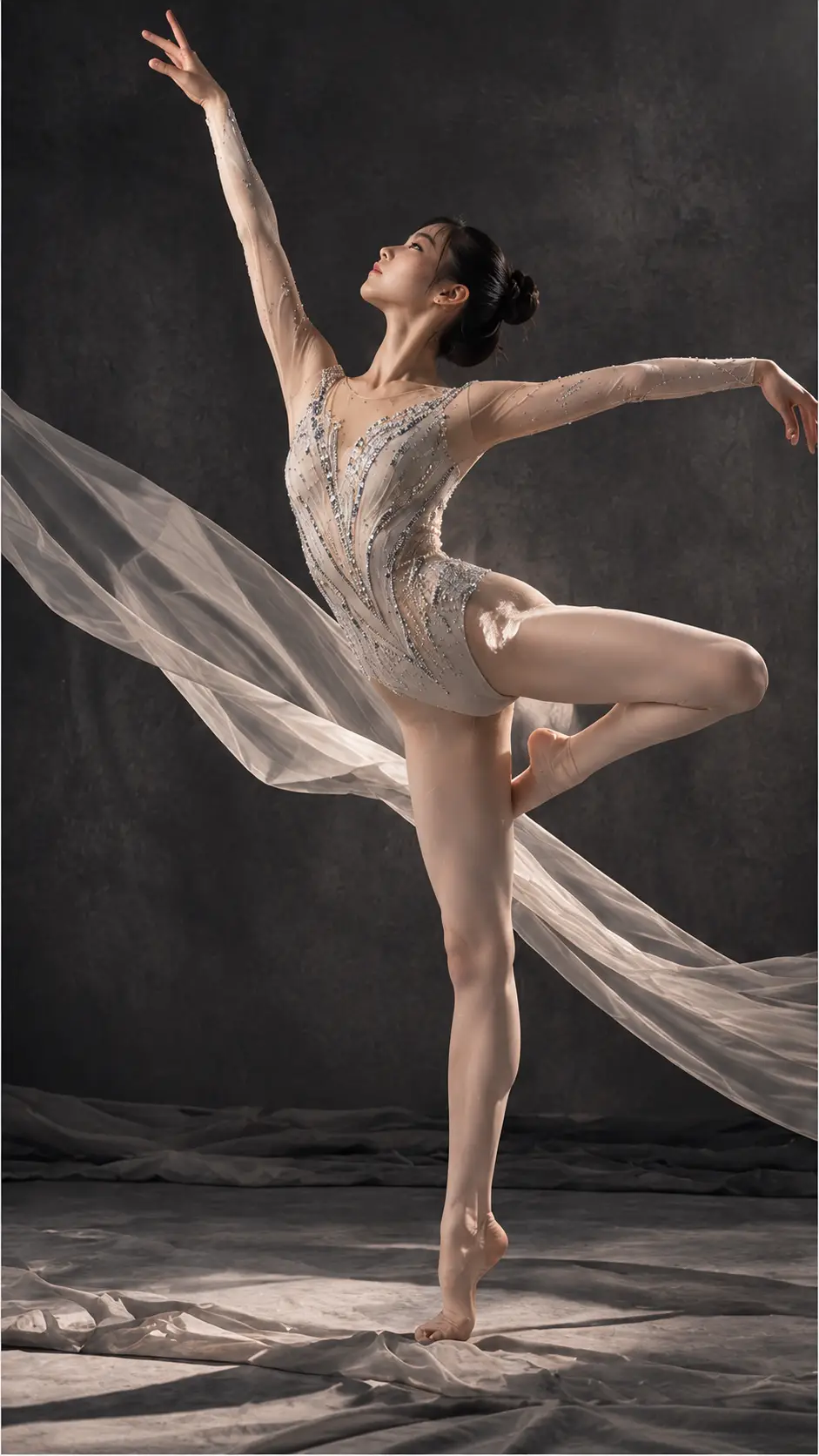
Beautiful, Brilliant, and Comfortable: What Gymnastics Leotard Fabric Really Needs to Do
More sparkle. More color. More visual impact. But never at the expense of movement or comfort. WOODA performance fabrics help gymnastics apparel designers explore the balance between brilliant surfaces, four-way stretch, soft hand feel, recovery, lightweight comfort, and a clean body-hugging silhouette.

The Best Gymnastics Leotard Is the One the Athlete Does Not Have to Think About
A gymnastics leotard can look spectacular when an athlete is standing still.
The real test begins when she moves.
She raises both arms overhead. She bends backward. She rotates through the shoulders. She performs a split. She tumbles, twists, jumps, lands, and immediately moves into the next element.
At that point, a beautiful design is not enough.
If the leotard rides up, wrinkles at the waist, digs into the leg opening, pulls at the shoulders, becomes loose after stretching, or forces the gymnast to adjust it repeatedly, the garment becomes a distraction.
That is exactly what performance apparel should avoid.
Gymnasts and parents discussing leotard fit frequently mention riding up and the frustration of having to pull a garment back into position during practice. Other athletes have discussed discomfort related to competition styles that make supportive undergarments difficult to wear. These are personal experiences rather than universal problems, but they highlight an important design principle: the athlete has to wear the design in motion, not simply look at it on a hanger.
For fabric buyers and gymnastics apparel manufacturers, this changes the question from:
“Does this fabric look beautiful?”
to:
“Does it still look beautiful after the gymnast starts moving?”

Gymnastics Leotard Fabric Has to Stretch—and Then Come Back
Stretch is an obvious requirement for gymnastics apparel.
Recovery is just as important.
A fabric may stretch easily, but if it does not return effectively toward its original shape, the garment can begin to look loose, wavy, wrinkled, or baggy after repeated movement.
That is especially noticeable around the waist, lower back, hips, shoulders, and leg openings.
A well-selected gymnastics leotard fabric should support multidirectional movement while helping the garment remain close to the body.
This is why manufacturers often evaluate both four-way stretch and recovery rather than stretch percentage alone.
The ideal sensation is not rigid compression.
It is controlled freedom.
The gymnast should be able to extend naturally without feeling that the garment is pulling her backward, while the fabric should recover sufficiently to maintain a clean silhouette when she returns to position.

It Should Stay Smooth—Not Bunch, Fold, or Wrinkle
One of the most frustrating problems in a fitted performance garment is excess fabric moving independently from the body.
Wrinkles around the waist.
Loose material at the lower back.
Fabric collecting around the hip.
A neckline that gaps.
A seat that shifts during tumbling.
These problems can come from sizing, pattern construction, garment engineering, or fabric behavior—and frequently from a combination of all four.
A recent gymnastics fit guide similarly emphasizes evaluating a leotard while the gymnast is actually moving because a garment that appears correct when standing still can ride up, twist, or shift during gymnastics movements.
For designers, that means the base textile needs sufficient elasticity and recovery to work with a close-fitting pattern.
The fabric should follow the body instead of fighting it—and recover instead of staying distorted.

Soft Enough for Skin. Strong Enough for Performance.
Gymnastics leotards are worn directly against the body.
That makes hand feel more important than it may appear on a specification sheet.
A fabric can have excellent color and beautiful shine but still feel too stiff, harsh, dry, or uncomfortable once it is stretched tightly over the body.
That sensation becomes more noticeable around sensitive areas such as the underarms, shoulders, neckline, waist, and leg openings.
Athletes also perspire and repeatedly flex the garment during training and competition.
For this reason, buyers should consider the complete wearing experience:
softness, elasticity, weight, surface texture, stretch tension, recovery, opacity, and interaction with seams and decoration.
The objective is not simply to find the softest possible material.
It is to find a balanced performance fabric that feels pleasant against the skin while maintaining the structure required by the garment.

Sparkle Is Beautiful. Heavy, Loose Decoration Is Not.
Gymnastics should be visually exciting.
Shine, crystals, metallic effects, foil, mesh, vivid colors, ombré effects, and novelty surfaces can transform a simple leotard into a memorable competition look.
But decoration needs control.
The current FIG Rhythmic Gymnastics Code allows decorative appliqués and details, but states that they should not create a safety issue and that appliqués should remain close to the base fabric rather than protruding excessively. It also requires sleeves to remain tight-fitting.
That principle aligns perfectly with good performance design.

Make it dramatic without making it cumbersome.
Instead of relying only on large, heavy, or dangling decorative elements, apparel designers can generate visual impact through the fabric itself.
This is where textile development becomes especially interesting.
A shiny stretch fabric can create light reflection across the entire garment.
A foil surface can introduce a stronger metallic effect.
Stretch mesh can create visual contrast and lighter-looking sections.
Novelty fabrics can introduce texture.
Different glossy and matte materials can be combined to emphasize body lines.
The garment can therefore look more luxurious and more dramatic without requiring every visual effect to come from additional objects attached to the garment.

Shine Has to Stretch Too
There is another challenge that apparel buyers sometimes discover only after sampling.
A fabric can look amazing when it is flat on a table—and completely different when stretched over the body.
The color may become lighter.
The surface may lose intensity.
The metallic appearance may change.
A printed pattern may distort.
The fabric may become more transparent.
Or a stiff decorative surface may reduce the stretch that the base construction originally provided.
This is why shiny gymnastics fabric should be evaluated in extension, not only in its relaxed state.
Buyers should ask:
How does the surface look at realistic garment stretch?
Does the shine remain attractive?
Does the hand feel become noticeably harder?
Does the fabric recover after extension?
Does it coordinate well with mesh or other panels?
Does the intended finish suit the expected laundering and wearing conditions?
The answers depend on the particular fabric construction and finishing technique, so sampling is an important part of development.

Better Comfort Can Also Create a Better Visual Result
Comfort and appearance are sometimes treated as opposite priorities.
For gymnastics apparel, they are closely connected.
When fabric stretches smoothly over the body, the design lines can look cleaner.
When recovery is strong, the silhouette can remain sharper.
When the fabric is lightweight and flexible, complex movement can look more natural.
When a textile feels comfortable, the gymnast has less reason to pull, adjust, or reposition the garment.
When a shiny surface is engineered on a suitable stretch base, designers can create visual impact without automatically adding bulky decoration.
In other words:
better performance can help the garment look better.

Supporting Evidence / Buyer Trust SectionWhat Gymnastics Apparel Buyers Should Evaluate
When sourcing fabrics for gymnastics leotards, competition uniforms, rhythmic gymnastics costumes, or related performance apparel, buyers should consider more than composition alone.
Depending on the project, important evaluation points may include:
Four-way stretch — Can the material accommodate extreme body movement in multiple directions?
Recovery — Does it return toward its original dimensions after repeated extension?
Hand feel — Is the surface comfortable when worn directly against the skin?
Stretch tension — Does the fabric feel supportive without creating excessive resistance?
Weight — Can it deliver coverage and stability without making the garment unnecessarily heavy?
Opacity — Does coverage remain appropriate when the fabric is stretched?
Surface stability — Does the shiny, printed, metallic, or foil effect behave appropriately during extension?
Color consistency — Can coordinated garments maintain a consistent appearance?
Decoration compatibility — Can the selected material work with crystals, appliqués, mesh panels, printing, or other required techniques?
GSM and width — Are the fabric specifications suitable for the pattern and manufacturing requirements?
Sample process, MOQ, lead time, and communication — Can the supplier support practical commercial development?
These details matter because high-movement sportswear demands more from fabric than ordinary fashion apparel.


Why Choose WOODA for Gymnastics Apparel Fabrics?
For a gymnastics brand, the ideal fabric brief can sound almost contradictory:
Make it softer—but keep the shape.
Make it stretch more—but do not let it become loose.
Make it lighter—but maintain appropriate coverage.
Make it brighter and more spectacular—but do not make it bulky.
Make it shine—but keep it comfortable.
This combination is exactly why specialized performance textile sourcing matters.
With more than three decades of textile experience behind the WOODA business, WOODA works with material categories including performance stretch fabrics, polyester-spandex fabrics, shiny fabrics, foil print fabrics, stretch mesh, tricot fabrics, and novelty fabrics for performance-apparel development.
Different WOODA fabrics offer different characteristics, and final suitability should always be confirmed through sampling according to the garment design and intended application.
But this range gives designers something extremely valuable:
options.
A smooth four-way stretch base can provide the foundation.
A brilliant shiny fabric can create focal panels.
A stretch mesh can create visual lightness.
A foil or specialty finish can increase stage impact.
A novelty surface can distinguish a collection from ordinary solid-color performance wear.
Instead of choosing between beautiful and comfortable, the development goal can become:
More beautiful.
More brilliant.
More flexible.
More comfortable.
More performance-ready.
That is the direction WOODA brings to gymnastics textile development.

WOODA: Let the Athlete Focus on the Performance
The athlete should be thinking about the landing.
The next turn.
The next leap.
The next connection.
Not about a wrinkle at the waist.
Not about a shoulder that feels restricted.
Not about a leotard that keeps riding upward.
Not about scratchy or excessively stiff fabric.
Not about heavy decorations moving against the body.
And certainly not about whether the garment will remain in place through the next skill.
The purpose of good gymnastics leotard fabric is to become almost invisible to the athlete while remaining highly visible to the audience.
It should disappear in terms of discomfort—
and stand out in terms of beauty.
That is where WOODA performance and specialty fabrics can help designers, gymnastics brands, dancewear manufacturers, costume makers, and international apparel buyers create the next generation of performance garments:
beautiful under the lights, comfortable against the body, flexible in motion, and designed to stay smooth throughout the performance.
Explore performance fabric possibilities through woodatex.com and texro.com.
Beautiful and Comfortable Gymnastics Leotards: Why Fabric Performance Matters
More sparkle. More color. More visual impact. But never at the expense of movement or comfort. WOODA performance fabrics help gymnastics apparel designers explore the balance between brilliant surfaces, four-way stretch, soft hand feel, recovery, lightweight comfort, and a clean body-hugging silhouette.
답글 남기기